


Gene Wilder was an American actor, writer, director, and author who became one of the most loved comedy stars of the twentieth century. He is best remembered for playing the mysterious chocolatier in Willy Wonka & the Chocolate Factory, but his career went far beyond that single role. From the wild-eyed panic of a nervous accountant in The Producers to the gentle mad scientist of Young Frankenstein, he showed that comedy could be tender, emotional, and unpredictable all at once. This article explains who he was, how he rose to fame, which films made him a star, what his private life was like, and why audiences still remember him today.
Quick Facts About Gene Wilder
| Detail | Information |
|---|---|
| Birth name | Jerome Silberman |
| Born | June 11, 1933, Milwaukee, Wisconsin, USA |
| Died | August 29, 2016, Stamford, Connecticut, USA (age 83) |
| Profession | Actor, screenwriter, director, author |
| Best-known roles | Willy Wonka, Leo Bloom, Dr. Frederick Frankenstein, the Waco Kid |
| Spouses | Mary Mercier, Mary Joan Schutz, Gilda Radner, Karen Boyer |
Early Life and Education
Gene Wilder was born Jerome Silberman in Milwaukee, Wisconsin, to a Jewish family with roots in Russia. His father made miniature beer and whiskey bottles for a living, and his mother, Jeanne, was a warm presence who also shaped the course of his life in an unusual way. When he was a child, his mother suffered from a serious illness, and a doctor reportedly advised him never to argue with her because it could harm her heart. Wilder later said that this moment pushed him to make her laugh, and that effort became the foundation of his comic talent.
He studied communication and theater arts at the University of Iowa and later trained at the Bristol Old Vic Theatre School in England, where he also learned fencing, a skill that would become useful in some of his later film roles. After returning to the United States, he moved to New York, studied acting seriously, and became a member of the Actors Studio. Because the name Jerome Silberman did not feel right for the stage, he chose a new one. The first name Gene came from a character in a novel by Thomas Wolfe, and the surname Wilder was a tribute to the playwright Thornton Wilder.
How Gene Wilder Got His Big Break
Wilder spent his early career working in theater, where he gained experience in small productions and on Broadway. During a Broadway production of Mother Courage and Her Children in the early 1960s, he met the actress Anne Bancroft, who introduced him to the comedy writer and director Mel Brooks. That introduction became one of the most important friendships in his professional life, because Brooks would later cast him in three of the funniest films ever made.
His first major screen appearance came in Bonnie and Clyde (1967), in which he played a frightened undertaker’s assistant who is briefly taken hostage by the gang. Although the role was small, his nervous energy made a strong impression on viewers and critics. Later that same year, he starred in Mel Brooks’ The Producers as Leo Bloom, an anxious accountant who becomes part of a scheme to produce a Broadway flop. The performance earned him an Academy Award nomination for Best Supporting Actor and turned him into a recognized name in Hollywood.
Willy Wonka & the Chocolate Factory (1971)
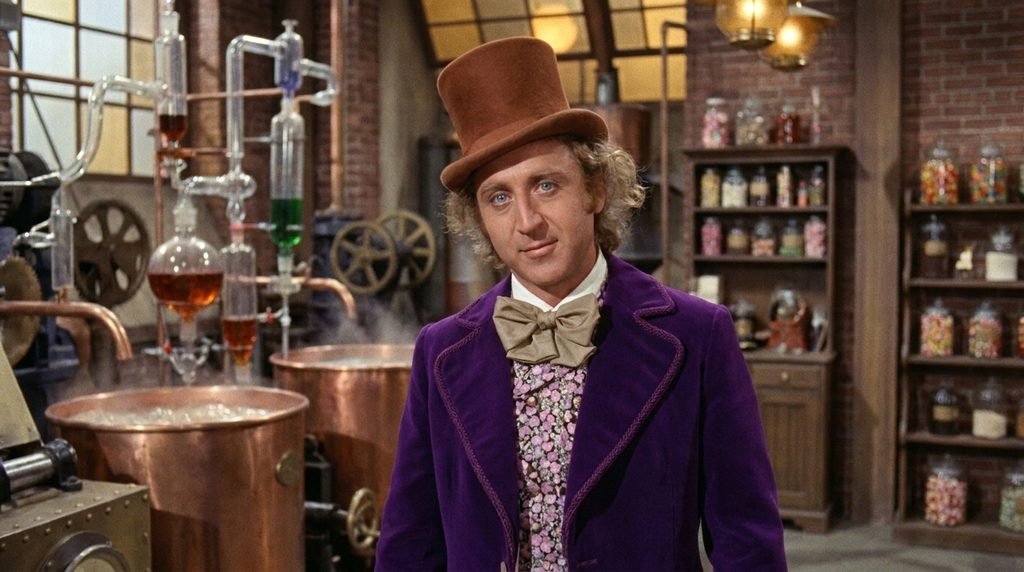
For many people, Gene Wilder will always be Willy Wonka. The 1971 film, directed by Mel Stuart and based on Roald Dahl’s children’s novel, introduced a version of the chocolatier who was charming, unpredictable, and slightly dangerous. Wilder reportedly asked for one particular detail in his first appearance: Wonka would walk out with a limp, fall into a somersault, and spring up again. His reasoning was that from that moment on, the audience would never know whether Wonka was telling the truth or lying.
The film did not become a major box office success when it was first released, but it grew into a cherished classic through television broadcasts and home video. Wilder received a Golden Globe nomination for his performance, and songs such as “Pure Imagination” became inseparable from his image. Over the years, he made it clear that he preferred the original film and did not wish to take part in later remakes, which says a lot about how personal the role was to him.
The Mel Brooks Years: Blazing Saddles and Young Frankenstein
The year 1974 was extraordinary for Wilder, because two of his most celebrated comedies were released within months of each other. In Blazing Saddles, he played Jim, known as the Waco Kid, a washed-up gunslinger who becomes a friend and ally to the new Black sheriff of a prejudiced frontier town. He joined the production at a late stage after the original actor, Gig Young, became unable to continue, and he fit the role so naturally that it is hard to imagine anyone else playing it.
Young Frankenstein was even more personal. Wilder came up with the idea and worked with Mel Brooks to write the screenplay, which gently mocked the classic horror films of the 1930s. He also starred as Dr. Frederick Frankenstein, a scientist who insists that his surname be pronounced “Fronkensteen” to distance himself from his notorious grandfather. The film was shot in black and white to match the look of the original monster movies, and the script earned Wilder and Brooks an Academy Award nomination for Best Adapted Screenplay. Together, these two films are often cited as the peak of 1970s American comedy.
Working With Richard Pryor
Another partnership that defined Wilder’s career was his friendship with the comedian Richard Pryor. The two appeared together in four films: Silver Streak (1976), Stir Crazy (1980), See No Evil, Hear No Evil (1989), and Another You (1991). Their on-screen chemistry worked because they were so different, with Wilder bringing a nervous, fast-talking innocence and Pryor bringing sharp, street-smart energy. Silver Streak and Stir Crazy in particular were major commercial hits, and they proved that Wilder could carry a film as a leading man outside the Mel Brooks universe.
Gene Wilder as Writer and Director
Wilder was more than a performer. He wrote and directed several films, including The Adventure of Sherlock Holmes’ Smarter Brother (1975), The World’s Greatest Lover (1977), and The Woman in Red (1984), in which he also starred. These projects showed his interest in romantic comedy and gentle humor, and they gave him creative control that acting alone could not provide. Later in life, he turned to writing books, including a memoir titled Kiss Me Like a Stranger: My Search for Love and Art (2005), along with novels and short story collections that reflected on love, memory, and the creative life.
Personal Life and Marriages
Wilder was married four times. His first marriage, to Mary Mercier, took place in 1960 and ended in 1965. He then married Mary Joan Schutz, and during that marriage he became stepfather to her daughter, Katharine, whom he later adopted. That marriage ended in the 1970s.
His third marriage, to the comedian Gilda Radner of Saturday Night Live, is the one most often remembered. The two met while making Hanky Panky (1982), appeared together in several films, and married in 1984. Radner was diagnosed with ovarian cancer and died in 1989, a loss that deeply affected Wilder. In response, he became an advocate for cancer awareness and supported the creation of Gilda’s Club, a support organization for people living with cancer and their families, which later became part of the Cancer Support Community.
In 1991, he married Karen Boyer, who had helped him prepare for See No Evil, Hear No Evil through her work with people who are deaf. They remained together until his death.
Later Career and Recognition
Wilder gradually stepped back from film acting in the 1990s, although he continued to take selected roles on television. His guest appearance as Mr. Stein on the sitcom Will & Grace earned him an Emmy Award for Outstanding Guest Actor in a Comedy Series in 2003. After that, he largely retired from acting and focused on writing, painting, and time with his family. In 1999 he was diagnosed with non-Hodgkin lymphoma, and he later went into remission.
Death and Legacy
Gene Wilder died on August 29, 2016, at his home in Stamford, Connecticut, from complications of Alzheimer’s disease. His family later explained that he had been diagnosed with the condition several years earlier but kept it private, because he did not want children who loved Willy Wonka to associate the character with illness or sadness. That choice captures much of who he was: a performer who cared about the joy he gave to others.
His legacy continues through the films that people still watch and quote today, through the comedians who cite him as an influence, and through the cancer support work connected to his name. He never won a competitive Academy Award, yet few actors have left behind such a large number of performances that audiences genuinely love.
Frequently Asked Questions About Gene Wilder
What was Gene Wilder’s real name?
His birth name was Jerome Silberman. He adopted the stage name Gene Wilder early in his acting career.
What is Gene Wilder most famous for?
He is most famous for playing Willy Wonka in the 1971 film, as well as for his roles in The Producers, Blazing Saddles, and Young Frankenstein.
How did Gene Wilder die?
He died from complications of Alzheimer’s disease on August 29, 2016, at the age of 83.
Was Gene Wilder nominated for an Oscar?
Yes, he received two nominations: Best Supporting Actor for The Producers and Best Adapted Screenplay for Young Frankenstein, which he shared with Mel Brooks.
Who was Gene Wilder married to?
He was married to Mary Mercier, Mary Joan Schutz, Gilda Radner, and Karen Boyer.
Disclaimer: This article is for general informational and educational purposes only. Details about Gene Wilder’s life and career may differ slightly in various accounts, and some information may change over time. All film titles, names, and trademarks mentioned belong to their respective owners, and this article is not affiliated with Gene Wilder’s family, estate, or any studio.
EXPLORE MORE: Alex Wagner: Biography, Career, Books, and What She Is Doing Now
If you are interested in exploring the lives of other influential figures and military leaders, you may also want to read our biographical profile on William F. Halsey and his naval career.


[…] EXPLORE MORE: Gene Wilder: Biography, Famous Movies, Personal Life, and Legacy […]
[…] If you are also interested in legendary figures from film and entertainment history, you may want to read our comprehensive profile on actor Gene Wilder. […]