


Aretha Franklin is widely considered one of the greatest singers in the history of popular music. Over a career of more than six decades, she turned gospel passion, jazz phrasing and blues feeling into a sound that people everywhere recognized within a few notes. Songs like “Respect,” “Chain of Fools” and “(You Make Me Feel Like) A Natural Woman” are still played around the world, and her voice remains a standard that other singers are measured against. This guide covers her early life, her rise to fame, her most important songs, her honors, her connection to the civil rights movement, her final years and the legacy she left behind.
Quick Facts About Aretha Franklin
| Detail | Information |
|---|---|
| Full name | Aretha Louise Franklin |
| Born | March 25, 1942, Memphis, Tennessee, USA |
| Died | August 16, 2018, Detroit, Michigan, USA (age 76) |
| Known as | The Queen of Soul |
| Genres | Soul, gospel, R&B, pop, jazz, blues |
| Best-known songs | “Respect,” “Chain of Fools,” “Think,” “I Say a Little Prayer,” “(You Make Me Feel Like) A Natural Woman” |
| Major honors | 18 competitive Grammy Awards, first woman inducted into the Rock and Roll Hall of Fame, Presidential Medal of Freedom |
Early Life: A Voice Shaped by the Church
Aretha Franklin was born in Memphis, Tennessee, and grew up mainly in Detroit, Michigan, the city she would stay tied to for the rest of her life. Her father, the Reverend C. L. Franklin, was one of the most famous Baptist preachers in the United States, and his sermons were recorded and sold to large audiences. Her mother, Barbara Siggers Franklin, was a gifted gospel singer and pianist. Barbara left the family home when Aretha was young and died in 1952, when Aretha was only ten years old, a loss that shaped Aretha’s childhood.
The family home was busy with music and visitors. Because her father was so well known, major gospel and jazz artists often came through the house, and a young Aretha heard and met performers who would later influence her own style. She taught herself to play the piano by ear, and she began singing solos at her father’s church, New Bethel Baptist Church in Detroit. By the age of fourteen she had recorded her first album, a collection of gospel songs released in 1956 under the title Songs of Faith. The church gave her more than a place to sing. It taught her how to build emotion slowly and then release it, and she carried that skill into every genre she later recorded.
The Columbia Records Years
In 1960, when she was still a teenager, Aretha decided to pursue secular music and moved to New York City. She signed with Columbia Records, where the talent scout John Hammond, who had also helped launch the careers of Billie Holiday and Bob Dylan, believed in her talent. Columbia recorded her in many styles, including jazz standards, show tunes and pop ballads. She had some modest hits during this period, such as “Won’t Be Long” in 1961, and critics admired her skill. But the label never fully found a way to showcase the raw, gospel-rooted power that made her special. Her time at Columbia is often described as a period of learning rather than a breakthrough.
The Atlantic Records Breakthrough
Everything changed in 1966 when Aretha signed with Atlantic Records and began working with producer Jerry Wexler. Instead of fitting her into a polished pop format, Wexler let her sing and play piano the way she naturally did. In January 1967, they recorded “I Never Loved a Man (the Way I Love You)” at FAME Studios in Muscle Shoals, Alabama, with a group of talented Southern session musicians. The song became a major hit and reached number one on the R&B chart, and it opened one of the most successful runs in recording history.
Only a few months later came the song that would define her career. “Respect” was written and first recorded by Otis Redding in 1965, but Aretha reshaped it so completely that it became her own. She added the famous spelled-out chorus, the “sock it to me” backing vocals sung with her sisters Carolyn and Erma, and a driving, confident energy. Her version reached number one on the Hot 100 and the R&B chart in 1967. In the context of the era, it was heard by many as an anthem for both the civil rights movement and the women’s movement, although Franklin herself spoke about it more simply as a song she loved. It won two Grammy Awards in 1968 and is regularly ranked among the greatest songs ever recorded.
Her Most Important Songs and Albums
The late 1960s and early 1970s were a remarkable creative peak. In a short time she released a series of hits that showed how many emotions her voice could carry. “Chain of Fools” (1967) is a tense, bluesy performance, while “(You Make Me Feel Like) A Natural Woman” (1967), written by Carole King, Gerry Goffin and Jerry Wexler, became one of the most beloved love songs ever recorded. “Think” (1968) was a fierce statement of independence, and her version of Burt Bacharach and Hal David’s “I Say a Little Prayer” (1968) became a lasting favorite. Her 1968 album Lady Soul gathered many of these songs, and in June of that year she appeared on the cover of Time magazine, a sign of how important she had become in American culture.
Her gospel roots returned in 1972 with Amazing Grace, a live album recorded over two nights at the New Temple Missionary Baptist Church in Los Angeles, with the choir led by Reverend James Cleveland. It became one of the best-selling gospel albums of all time. A film of the recording sessions, directed by Sydney Pollack, was shelved for decades because of technical problems with the sound and picture. It was finally released to audiences in 2018 and 2019, allowing a new generation to see the performance.
Her success continued in later decades. She scored hits such as “Until You Come Back to Me (That’s What I’m Gonna Do)” in 1973, and after moving to Arista Records in 1980 she returned to the top of the charts in the mid-1980s with “Freeway of Love” and “Who’s Zoomin’ Who?” In 1985 she joined the Eurythmics for “Sisters Are Doin’ It for Themselves,” and in 1987 her duet with George Michael, “I Knew You Were Waiting (For Me),” reached number one on the Hot 100. She also reached a new audience through her memorable appearance as a diner owner in the 1980 film The Blues Brothers, where she performed “Think.”
Awards and Records
Aretha Franklin’s list of honors is one of the longest in American music. She won 18 competitive Grammy Awards, including eight in a row for Best R&B Vocal Performance, Female, between 1968 and 1975. She also received the Grammy Legend Award in 1991 and the Grammy Lifetime Achievement Award in 1994. In 1987 she became the first woman inducted into the Rock and Roll Hall of Fame.
Her recognition went well beyond the music industry. She received the Kennedy Center Honors in 1994, the National Medal of Arts in 1999 and the Presidential Medal of Freedom in 2005. She placed more than 70 songs on the Hot 100, among the most for any woman in the chart’s history, and she is regularly named the greatest singer of all time in major rankings. In 1985, the state of Michigan declared her voice a natural resource, a rare honor that reflects how deeply she was valued in her home state. In 2019, after her death, she was awarded a special Pulitzer Prize citation for her contribution to American music and culture over more than five decades.
Aretha Franklin and the Civil Rights Movement
Franklin’s connection to the civil rights movement began at home. Her father was a friend and supporter of Dr. Martin Luther King Jr., and the family knew many movement leaders personally. Aretha supported the cause through benefit concerts and donations, and when King was assassinated in 1968, she sang “Precious Lord, Take My Hand” at his funeral. In 1970 she publicly offered to help pay bail for activist Angela Davis, explaining that she believed in freedom for Black people. These actions, together with the message many listeners heard in her music, helped make her more than an entertainer in the eyes of many Americans.
Famous Performances and Moments
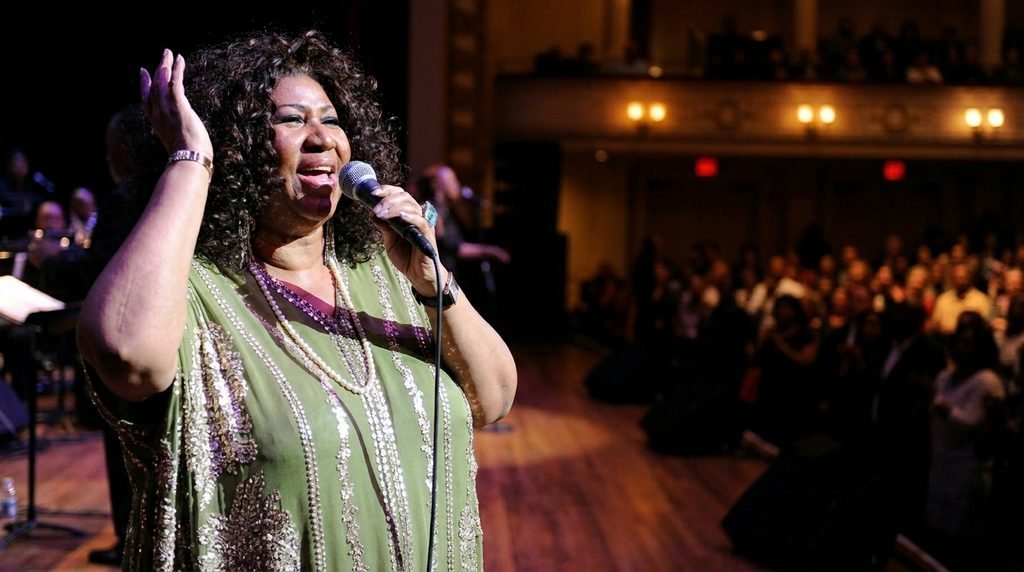
Some of her live appearances became part of American history. She sang at the inauguration of President Barack Obama in 2009, when her performance of “My Country, ’Tis of Thee” and her large, bow-trimmed hat drew attention across the world. In 1998 she stepped in at the last minute at the Grammy Awards to sing “Nessun Dorma” in place of the ill opera star Luciano Pavarotti, and the performance is still remembered as a remarkable act of musical skill. In 2015, at the Kennedy Center Honors celebrating Carole King, she sang “(You Make Me Feel Like) A Natural Woman” with such power that it moved the audience, including President Obama, to tears. That same year she also sang for Pope Francis in Philadelphia.
Personal Life
Franklin was a private person who rarely discussed her family life in detail. She had four sons and was married twice, first to Ted White, who also managed her early career, and later to the actor Glynn Turman. She developed a fear of flying that led her to avoid air travel for much of her later career, so she often traveled across the United States by bus or car. Despite her fame, she kept strong ties to Detroit and to the church where her musical journey began.
Final Years and Death
Aretha Franklin continued to perform and record well into her seventies. In 2014 she released Aretha Franklin Sings the Great Diva Classics, and her final public performance took place in November 2017 at an Elton John AIDS Foundation event in New York City. She died on August 16, 2018, at her home in Detroit at the age of 76, from advanced pancreatic cancer of the neuroendocrine type. Tributes came in from presidents, musicians and fans around the world, and her public viewing in Detroit lasted several days. Her funeral on August 31, 2018, at Greater Grace Temple included performances and speeches by artists and public figures, including Stevie Wonder, Ariana Grande and Jennifer Hudson. She was laid to rest at Woodlawn Cemetery in Detroit.
Legacy and Influence Today
Aretha Franklin’s influence is easy to hear in modern music. Singers across soul, pop, gospel and R&B, from Whitney Houston to Alicia Keys and Beyoncé, have named her as a major inspiration, and her phrasing, her piano playing and her ability to make a song feel personal have become a model for vocalists. Her story has also reached new audiences through screen projects, including the 2021 film Respect, in which Jennifer Hudson played her (Franklin had chosen Hudson for the role before she died), and the 2021 television series Genius: Aretha, starring Cynthia Erivo.
After her death, questions about her estate also became a public topic, because handwritten documents were found at her home. In 2023, a Michigan jury decided that a 2014 handwritten document was a valid will. This legal matter does not change her musical legacy, but it explains why her name appeared in the news long after her passing. Today, her music continues to find new listeners, and “Respect” remains one of the most recognized songs in the world.
Frequently Asked Questions About Aretha Franklin
Why is Aretha Franklin called the Queen of Soul?
The nickname came from the combination of her powerful gospel-trained voice, her string of soul hits in the late 1960s and her lasting influence on the genre. It became the title most closely linked with her name.
What is Aretha Franklin’s most famous song?
“Respect” is her best-known song. Her 1967 version reached number one on the Hot 100, won two Grammy Awards and is often ranked among the greatest recordings ever made.
Did Aretha Franklin write “Respect”?
No. Otis Redding wrote and first recorded the song in 1965. Franklin’s arrangement added new elements, including the spelled-out chorus, and made it a different and far more famous song.
How many Grammy Awards did Aretha Franklin win?
She won 18 competitive Grammy Awards, along with two special honors: the Grammy Legend Award and the Lifetime Achievement Award.
How did Aretha Franklin die?
She died in Detroit on August 16, 2018, from advanced pancreatic cancer of the neuroendocrine type.
Where was Aretha Franklin from?
She was born in Memphis, Tennessee, but she grew up in Detroit, Michigan, and is closely linked with that city.
What albums should a new listener start with?
Good starting points are I Never Loved a Man the Way I Love You (1967), Lady Soul (1968) and the live gospel album Amazing Grace (1972)
Disclaimer: This article is for general information and education only. Statistics such as chart entries, award counts and rankings can change or be counted differently over time, so please verify key facts before relying on them. This content is not legal, financial or medical advice, and it is not affiliated with or endorsed by Aretha Franklin’s estate, her record labels or any company mentioned.
EXPLORE MORE: Julian Broadus: Who Is Snoop Dogg’s Son? Age, Mother, Family and Career


[…] EXPLORE MORE: Aretha Franklin: Life, Music, Awards and Legacy of the Queen of Soul […]