

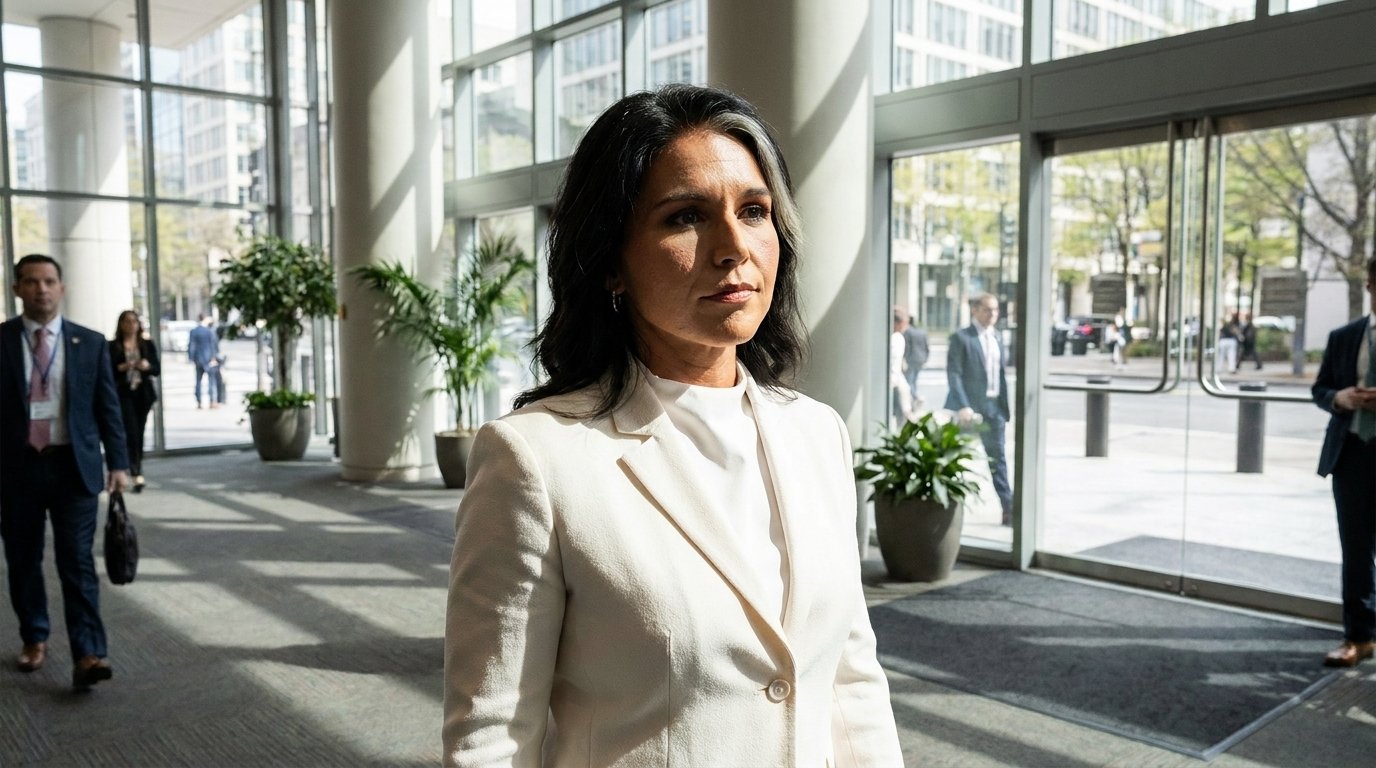
Tulsi Gabbard is one of the most unusual figures in recent American politics. She is a Hawaii Democrat and Iraq-era veteran who ran for president in 2020, left her party in 2022, and later became President Donald Trump’s Director of National Intelligence. Her time in that job ended in 2026 with a resignation that raised as many questions as it answered.
This guide brings together what is publicly confirmed about her life, her political career, her time leading the U.S. intelligence community, and where things stand as of late October 2026. Some pages that rank for her name still describe her as the sitting director, which is out of date, and others repeat claims without naming a source, so this article marks the points where reports disagree or where nothing has been confirmed.
Who Is Tulsi Gabbard? Quick Facts
| Detail | What is confirmed |
|---|---|
| Born | April 12, 1981 (age 45 as of October 2026) |
| Birthplace | Leloaloa, American Samoa |
| Education | Business degree from Hawaii Pacific University, 2009 |
| Highest office held | Eighth Director of National Intelligence |
| Senate confirmation | February 12, 2025, by a 52–48 vote |
| Departure from office | Announced for June 30, 2026 (one reference work lists June 19) |
| Current government post | None found in public reporting as of October 27, 2026 |
Early Life, Hawaii Politics, and Military Service
According to a CNN profile, Gabbard’s family moved from American Samoa to Hawaii in 1983, and she grew up in a household closely tied to local politics. Her father, Mike Gabbard, later became a Hawaii state senator, and her mother, Carol, served on the state’s Board of Education. Gabbard herself was first elected to the Hawaii House of Representatives at 21, but she left after one term when her National Guard unit was sent overseas.
She enlisted in the Hawaii Army National Guard in 2003 and deployed to Iraq with a medical unit in 2004 and 2005. A few years later she went to Kuwait, where she trained counterterrorism units. She kept serving while she was in Congress and afterward, eventually reaching the rank of lieutenant colonel in the Army Reserve. This military record became the foundation of her public image as a politician who opposed foreign wars from the perspective of someone who had served in one.
Congress, the DNC, and the 2020 Presidential Run
Voters in Hawaii’s 2nd District sent her to the U.S. House in 2012, and CNN describes her as the first American Samoan congresswoman. Early in her congressional career she was elected a vice chair of the Democratic National Committee, a post she gave up in 2016 so she could endorse Bernie Sanders for president. Over the following years she built a reputation as an independent voice who often clashed with her own party’s leadership on foreign policy.
One of the most debated moments came in 2017, when she said she was skeptical that the Syrian government was behind a chemical weapons attack, even though the president, the secretary of state, and Pentagon officials had concluded that it was. She launched her presidential campaign in February 2019, gained attention for sharp exchanges on the debate stage, and announced that autumn that she would not seek another House term. After leaving the race she endorsed Joe Biden, and she departed Congress in early 2021.
How Tulsi Gabbard Moved From the Democratic Party to Trump’s Cabinet
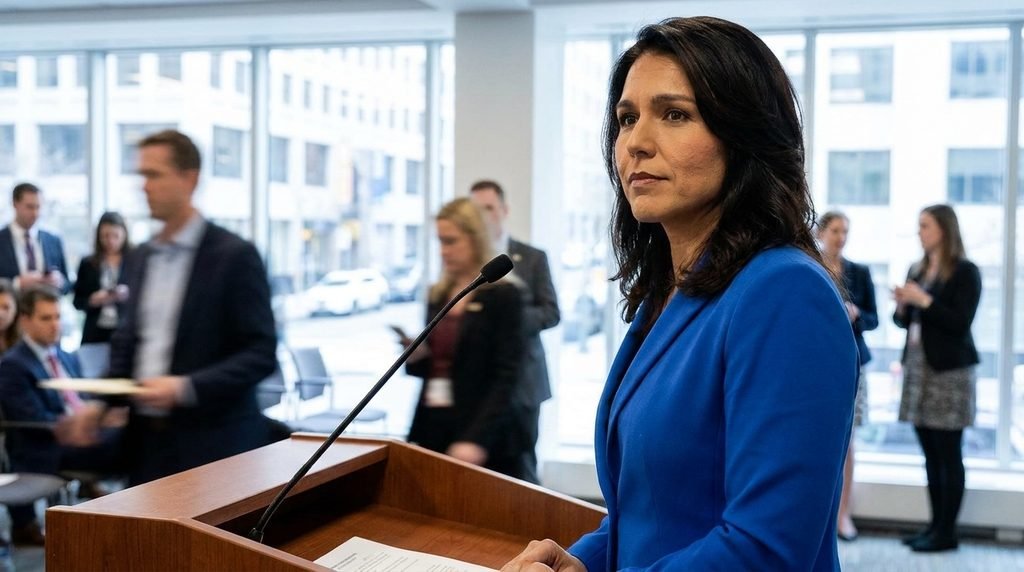
In October 2022 she announced that she was leaving the Democratic Party, describing it as an “elitist cabal of warmongers.” Over the next two years she moved steadily toward conservative positions on issues such as border security and transgender rights, and in October 2024 she joined the Republican Party at a rally with Trump. She also served on his transition team after the election.
Trump announced on November 13, 2024, that he had chosen her to lead the Office of the Director of National Intelligence. The nomination was one of the more controversial of his second term, partly because she had little background in intelligence work and partly because her earlier remarks about Syria and Russia’s invasion of Ukraine drew scrutiny during vetting. Supporters, including many veterans and Republican senators, pointed to her military service and years on a House intelligence subcommittee as relevant experience.
What She Did as Director of National Intelligence
Reforms, Cuts, and Declassification
Gabbard said her main goal was to end what she called the politicization of intelligence. She launched an overhaul known as “ODNI 2.0,” which shrank the office and was reported to include a workforce cut of around 40 percent. Her supporters also credited her with closing diversity programs inside the office, creating a government-wide Weaponization Working Group, and releasing a large amount of previously classified material. One outlet reported savings of more than $700 million a year and more than 500,000 declassified pages, but those figures come from a single secondary report and I could not confirm them in official documents.
She also used the office’s power over security clearances, revoking the clearances of several former intelligence officials, including former CIA Director John Brennan. A task force she created, the Director’s Initiatives Group, later became a source of friction with the White House, according to a source cited by Reuters. In 2025 she also pushed a report on the Obama-era Russia investigation, describing it as a conspiracy against Trump, a characterization that Democrats and other critics disputed.
The Controversies
Several episodes drew criticism from both parties. In early 2026 she appeared at an FBI search of an election office in Fulton County, Georgia, where agents seized records from the 2020 election. She told senators that she was there at the president’s request, though administration officials later gave shifting explanations, and former intelligence officials and election-law experts told CNN that she had no legal authority over the search and that her presence blurred the line between foreign and domestic intelligence work. Her office also confirmed it had a role in the seizure of voting machines in Puerto Rico.
Lawmakers also pressed her over a whistleblower complaint about her conduct, which an attorney for the whistleblower said was held back from Congress for about eight months. Her office denied any wrongdoing, and Republican leaders on the intelligence committee defended her after reviewing the document, while Democrats called for her to resign. The details of the complaint were not released in the coverage I reviewed.
The deepest strain with the White House involved Iran. In 2025 she told Congress that U.S. agencies did not believe Iran had decided to build a nuclear weapon, and after the U.S. strikes on Iranian nuclear sites that June, Trump said she was wrong. When the United States joined Israel in attacking Iran on February 28, 2026, her top counterterrorism official, Joe Kent, resigned on March 17 and said Iran posed no imminent threat. At a Senate hearing the next day she said it was the president’s role, not the intelligence community’s, to decide what counts as imminent. Trump had said earlier in March that she was softer than he was on Iran, and some reports also said she was sidelined during the operation to seize Venezuelan leader Nicolás Maduro.
Why She Resigned: The Official Reason and the Reports
She announced her resignation on Friday, May 22, 2026, after telling Trump in an Oval Office meeting. In a letter posted on X, she said her husband, Abraham Williams, had been diagnosed with an extremely rare form of bone cancer and that she could not continue in such a demanding role while he faced treatment. Trump publicly thanked her, saying she had done a great job and rightly wanted to be with her husband. Republican senator Eric Schmitt praised her record, while Democrat Adam Schiff said her departure was the most positive thing she had done for national security.
Reuters reported that a source familiar with the matter said the White House had forced her out, and that the dispute over the Director’s Initiatives Group and her stance on Iran were factors. That claim rests on an unnamed source, and neither Gabbard nor the White House has confirmed it, so the only publicly confirmed reason is the family health explanation. Both versions can be partly true, and the timing alone is not proof of either.
Who Replaced Her at ODNI
Trump first said her deputy, Aaron Lukas, a former CIA officer, would serve as acting director. In June, however, he named Bill Pulte, the head of the Federal Housing Finance Agency, as acting director instead, which drew criticism from Democrats and some Republicans because Pulte had no intelligence experience. Pulte later said he cut roughly 30 percent of the office’s staff during his short stint.
On June 11, Trump nominated Jay Clayton, the U.S. attorney for the Southern District of New York and a former SEC chairman. The process was delayed after Trump told Clayton not to appear at his first scheduled hearing, and a hearing finally took place on July 15. The Senate confirmed Clayton on July 28, 2026, by a 51–47 party-line vote. The dispute over the post had also contributed to a lapse in a surveillance authority known as Section 702 of the Foreign Intelligence Surveillance Act, which senators hoped to renew once a permanent director was in place.
What She Has Done Since Leaving Office
Gabbard has kept a low public profile. On August 20, 2026, she posted a video on X explaining that her husband has sacral chordoma, a rare cancer near the base of the spine, and that he had undergone major surgery. She said doctors were confident they had removed all of the cancerous tissue, that he had spent almost three months in physical therapy, and that he would need regular MRI scans to watch for a return of the disease, adding that the battle was not over.
No new job, campaign, or book deal has been announced in the reports I found. Social media posts claiming that she is preparing a political comeback or taking a specific role should be treated as unconfirmed until she or a reliable news outlet says so.
Rumors and Outdated Claims
Claims that Tulsi Gabbard is a Russian asset have followed her since 2019, when Hillary Clinton suggested that Russia was grooming a Democratic presidential candidate, a remark widely understood to refer to her. Gabbard rejected the suggestion, and no public evidence has been presented to support it. Critics do point to her past comments on Syria and Ukraine as the reason the question keeps resurfacing, while her defenders see the label as a smear aimed at an anti-war politician.
Dates are another area where errors spread. A few outlets say she endorsed Trump in 2020, but other reports place her endorsement and her switch to the Republican Party at the October 2024 rally, and the later date is the one consistent with her own timeline. Anyone describing her as the current Director of National Intelligence is also working from old information.
Frequently Asked Questions
Is Tulsi Gabbard still Director of National Intelligence?
No. She left the office in mid-2026, and the Senate has since confirmed a permanent successor.
What is Tulsi Gabbard’s net worth?
A single reliable figure has not been publicly confirmed. Many websites list estimates that differ widely and rarely show their sources, so the safest sources are her official financial disclosure filings from her time in Congress and in the administration.
What does the Director of National Intelligence actually do?
The DNI coordinates the work of 18 U.S. intelligence agencies and acts as the president’s main intelligence adviser, including preparing the daily intelligence briefing. Congress created the post after the September 11 attacks, and it began operating in 2005, according to CNN.
What is her religion?
She is a practicing Hindu, and CNN describes her as the first practicing Hindu member of the U.S. Congress.
Will she run for office again?
She has made no announcement about running for any office, and any report of a 2028 campaign is speculation at this point.
What does her husband do for work?
Abraham Williams has stayed out of politics, and outlets disagree on how to describe his job, with some calling him a cinematographer and others a photographer, so his exact profession is not confirmed here.
Conclusion
The story of Tulsi Gabbard so far is one of sharp turns, from Hawaii legislator to anti-war Democrat to a Republican cabinet member who left under a cloud of competing explanations. The most reliable way to follow what comes next is to rely on her own public statements and official records rather than anonymous social media posts.
Disclaimer
This article is for general information only and reflects public reporting available as of October 27, 2026. Political events and official statements can change quickly, and some details, including exact dates and unnamed-source claims, may be updated or corrected later. It is not legal, medical, or financial advice, and readers should check official sources for the latest facts.
EXPLORE MORE: Geena Davis: Biography, Famous Roles, Advocacy and Latest News (2026)


[…] EXPLORE MORE: Tulsi Gabbard: Career, Resignation as DNI, and What Is Confirmed Since […]