

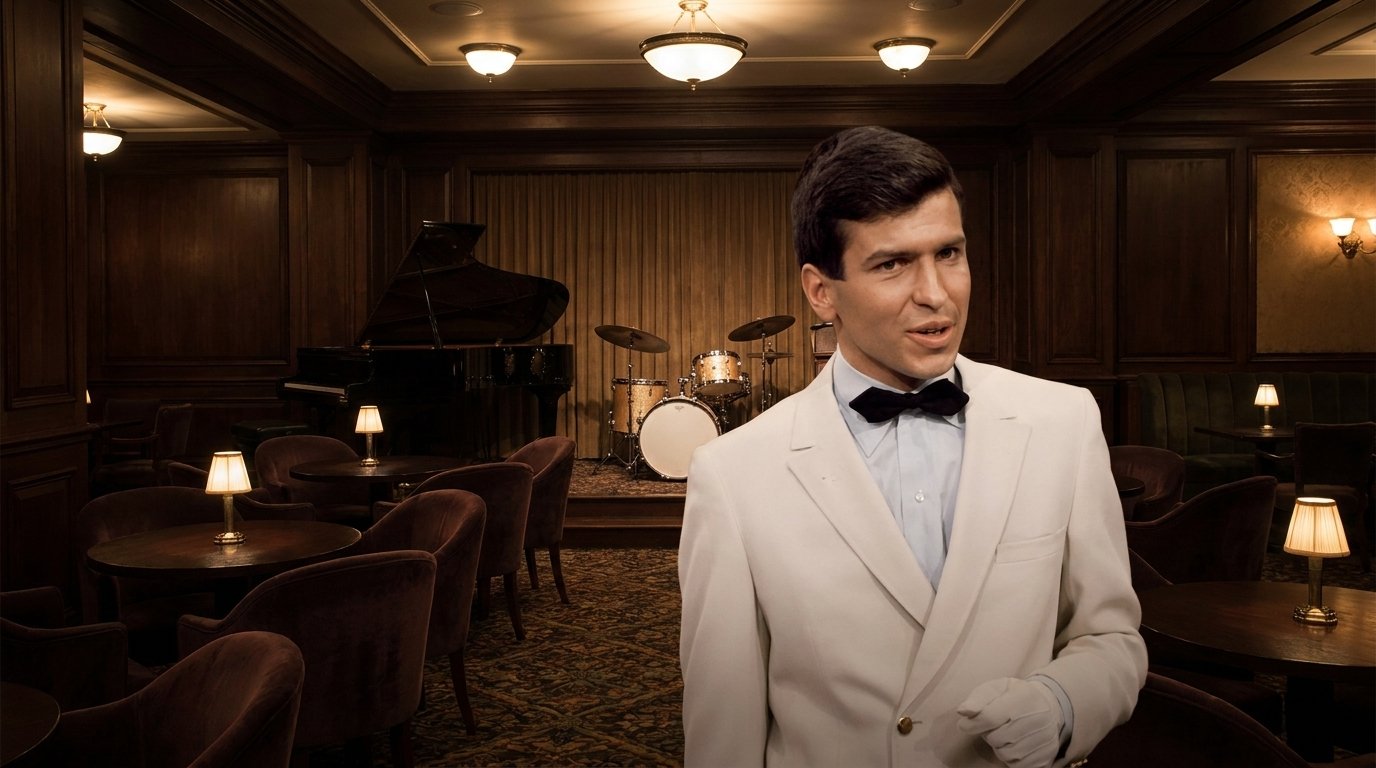
Frank Sinatra Jr. spent his whole career answering one question: what is it like to be the son of the most famous singer of the twentieth century? He worked as a singer, songwriter, conductor and occasional actor, yet many people first hear his name through a shocking kidnapping in 1963 or through his later years leading his father’s orchestra. This guide brings together what major news outlets, the FBI and other reliable records confirm about his life, and it points out the many details that online profiles get wrong or cannot prove.
Quick Facts
| Detail | What is confirmed |
|---|---|
| Birth name | Francis Wayne Sinatra |
| Born | January 10, 1944, in Jersey City, New Jersey |
| Died | March 16, 2016, in Daytona Beach, Florida, aged 72 |
| Cause of death | Cardiac arrest, according to a statement from the Sinatra family |
| Parents | Frank Sinatra and his first wife, Nancy Barbato Sinatra |
| Siblings | Nancy Sinatra (older sister) and Tina Sinatra (younger sister) |
| Known as | Singer, songwriter, conductor, actor |
| Debut album | Young Love for Sale (1965, Reprise Records) |
| Last album of new material | That Face! (2006, Rhino) |
| Net worth | No verified figure has been published |
Early Life of Frank Sinatra Jr.
He was born in Jersey City, New Jersey, just as his father’s career was taking off, and he grew up in a house where music was the family business. According to the Associated Press, he usually watched his father from a distance because the elder Sinatra was constantly away on tour or making films. Reference biographies add that his father discouraged him from entering the music world because of its instability, but the son followed his own path anyway, starting with local clubs when he was in his early teens.
By the age of 19 he had joined the band of bandleader Sam Donahue as a vocalist, and he also spent time around Duke Ellington, who helped him understand how the music business worked. As a boy he had been able to see performers such as Dean Martin, Sammy Davis Jr. and Count Basie at work, an education few young musicians could match. Reporters later noted that his voice and phrasing were close enough to his father’s that comparisons were unavoidable from his first professional bookings.
The 1963 Kidnapping of Frank Sinatra Jr.
The event that made him a household name happened on the evening of December 8, 1963, when he was 19 and had only just begun performing professionally. The FBI’s own case history says two 23-year-old former high school classmates from Los Angeles, Barry Keenan and Joe Amsler, had followed him from city to city for weeks. At around 9 p.m. at Harrah’s Club Lodge in Lake Tahoe, Keenan knocked while pretending to deliver a package, and the pair then entered, taped up a friend who was with the young singer, blindfolded him and took him out to a waiting car. Police set up roadblocks and actually stopped the car, but the kidnappers bluffed their way through and reached a hideout in a Los Angeles suburb.
The FBI’s Reno office was involved within about forty minutes, and agents met the singer’s father in Reno and his mother in Bel Air. A third man, John Irwin, acted as the ransom contact and passed along a demand for $240,000 on December 10. The elder Sinatra gathered the cash, the FBI photographed it, and the drop was made between two school buses in Sepulveda, California, in the early hours of December 11. While Keenan and Amsler collected the money, Irwin lost his nerve and released the captive, who walked for a few miles and alerted a security guard in Bel Air. To avoid reporters, the FBI says, he was hidden in the trunk of the guard’s patrol car and taken to his mother’s home.
The case came apart quickly. Irwin told his brother what had happened, the brother called the FBI office in San Diego, and within hours Keenan and Amsler were arrested and nearly all of the ransom was recovered. All three men were convicted. Keenan later told public radio host Ira Glass that he had intended to repay the money over time, a claim that did little to change how the crime is remembered. The story has since been dramatized, including in a 2003 film titled Stealing Sinatra.
Building His Own Music Career
His recording debut came with Young Love for Sale in 1965, released on Reprise, the label his father had founded. The album leaned on Great American Songbook standards and was arranged in a style so close to his father’s records that critics treated it as an homage as much as a debut. Trade coverage after his death stated plainly that he never had a hit under his own name, which makes his long touring career all the more notable. In 1965 he also composed music for the low-budget film The Beach Girls and the Monster, and by 1968 one profile reports he had performed in 47 states and 30 countries.
Colleagues described him as a demanding bandleader. A guitarist quoted in a Washington Post profile said he knew every part in an arrangement, from the third trombone to the cellos, and he developed a reputation for strict rehearsals. He also hosted a ten-week summer replacement series for The Dean Martin Show and opened for bigger acts in Las Vegas. Looking back late in life, he told the Daytona Beach News-Journal that the music of his generation had moved on and that he had been “trying to sell antiques in a modern appliance store.”
Conducting for His Father
In 1988, at his father’s request, he put his own career on hold to become the elder Sinatra’s musical director and conductor. The Las Vegas Review-Journal reports that he led the stage orchestra at Bally’s and the MGM Grand until his father’s last performances on the Strip in 1993. Poet and vocalist Rod McKuen wrote that the arrangement kept his father connected to live audiences at a time when most of the older conductors and arrangers around him had died.
After the elder Sinatra died of a heart attack on May 14, 1998, at the age of 82, the son became a living link to the catalog. He told the Associated Press that many fans were not ready to give up the music, and he toured for years with tribute shows. One of them played the MGM Grand in 2002 with a 36-piece orchestra, according to the Review-Journal.
Acting and Television Appearances
He took small screen and film roles throughout his career, usually in guest spots rather than leading parts. Early credits include A Man Called Adam (1966) with Sammy Davis Jr. and three episodes of the police drama Adam-12 as officer Tom Boyd. Later film credits include Code Name Zebra (1987) and Hollywood Homicide (2003). He also played himself on The Sopranos in the 2000 episode “The Happy Wanderer,” a nod to the long-running stories about his father’s mob associations.
Younger audiences may know him best from Family Guy, where he sang alongside Brian and Stewie in “Brian Sings and Swings” and again in a 2008 episode. A third appearance, “Bookie of the Year,” aired on October 2, 2016, after his death and was dedicated to his memory, which makes it his final screen credit. In the late 1990s he was also offered the role of the singer Vic Fontaine on Star Trek: Deep Space Nine but declined, saying he preferred to play an alien, and James Darren took the part.
Later Years and Final Projects
That Face!, released in 2006, was his first album of new material in about a decade, and it included “Spice,” a song he wrote himself. In his final years he sang “Theme from New York, New York” at the 2014 Belmont Stakes and performed the national anthem at Yankee Stadium on August 17, 2015. His song “Black Night” was used as the theme for the 2015 film Entertainment, and he sang “I’ve Been Around” on Patrick Williams’s album Home Suite Home, which earned a Grammy nomination for Best Large Jazz Ensemble Album and is believed to be his last studio session.
His health also became part of the public record. Several outlets reported that he went through cancer treatment in the 2000s, but they describe the details differently, so the exact diagnosis and dates are not consistently confirmed in the sources reviewed for this article.
How and Where Frank Sinatra Jr. Died
He died on March 16, 2016, while on tour in Daytona Beach, Florida. The Sinatra family told the Associated Press that the cause was cardiac arrest and that it came unexpectedly, and no further medical details were released. His sister Nancy posted a message on Facebook that ended with the words “Sleep warm, Frankie.” The Peabody Auditorium, where he was due to perform that night as part of his “Sinatra Sings Sinatra” centennial tour, cancelled the show, and the Daytona Beach News-Journal reported that he died at Halifax Health Medical Center.
Tributes came quickly from the music world, including from singer Tony Bennett, who sent sympathy to the family on social media. According to the Associated Press, the singer had other tour dates already booked for May, September and October of that year in the Midwest and on the East Coast.
Personal Life and Family
He married Cynthia McMurry on October 18, 1998, and the couple divorced on January 7, 2000, according to published records summarized in his biography. His sisters, Nancy and Tina, remained prominent in the entertainment world throughout his life.
Questions about his children appear often in search results, but the information is inconsistent. His obituary acknowledged one biological son, while other people have publicly claimed to be his children without his acknowledgment during his lifetime. Because several of those claims are disputed and involve private individuals, this article does not name them, and readers should treat family-tree websites with caution.
Common Mistakes and Conflicting Claims Online
The top-ranking pages for this topic vary widely in quality, and several are clearly auto-generated, with sentences cut off mid-thought and facts that contradict each other. The table below lists the errors that appear most often and what better sources show.
| Claim you may see | What reliable sources show |
|---|---|
| Born on “10 July” or in 1943 | Reference works give January 1944. His age of 72 at death only fits a 1944 birth, so a 1943 birth year in one wire version appears to be an error |
| Debut album released in 1963 | Young Love for Sale came out in 1965, according to multiple music outlets |
| Tina Sinatra is his “younger brother” | Tina is his younger sister |
| Full name “Franklin Wayne Sinatra” | The Associated Press gives Francis Wayne Sinatra |
| Kidnapped from Room 417 | One reference work names a hotel room, while the FBI describes him resting in a dressing room at the lodge, so the exact room is not consistently documented |
| Joined the Tommy Dorsey band | Reference works say Sam Donahue’s band, while some music profiles describe the same early job as playing with the Tommy Dorsey band |
Legacy of Frank Sinatra Jr.
Critics were divided on how to rate his career. A 2003 Variety review praised his deep experience in big-band music and his feel for lyrics, while trade writers noted that he never matched his father’s chart success. Both views can be true at once: he built a long, steady career, kept a demanding orchestral tradition alive, and became the person audiences trusted to carry his father’s songs into the twenty-first century. The United States National Archives also holds a 15-minute song and monologue he composed in 1976 called “Over the Land,” which is a reminder that his own creative work extended beyond the family catalog.
Frequently Asked Questions
Was Frank Sinatra Jr. really a “junior”?
Not in the strict sense. His father’s full name was Francis Albert Sinatra, while he was born Francis Wayne Sinatra, so the middle names differ. He was nonetheless known as Frank Jr. for his whole life.
Did Frank Sinatra Jr. stage his own kidnapping?
No evidence supports that claim. The defense lawyers for the kidnappers argued in court that it was a publicity stunt, but the FBI says it had strong evidence to the contrary, including a confession letter Keenan wrote earlier and left in a safe-deposit box.
How long did the kidnappers spend in prison?
Reports of the original sentences conflict, with some listing life terms or 75 years and another listing 12 years for Keenan. Several accounts agree that, after appeals, Amsler and Irwin served about three and a half years and Keenan roughly a year more, and one reference work says Keenan was later judged legally insane at the time of the crime.
Why did the elder Sinatra carry dimes for the rest of his life?
According to an Associated Press report from 1998, the kidnappers demanded that all contact take place by payphone, and the singer worried about running out of coins during those calls. He reportedly carried ten dimes from then on and was buried with ten dimes in his pocket.
Did he ever have a hit record of his own?
Industry coverage after his death says he never had a hit under his own name. His reputation rested instead on live performance, conducting and tribute work.
What was his net worth?
There is no verified figure. Estimates on celebrity wealth sites are usually unsourced and differ from one page to the next, so they should not be treated as fact.
Conclusion
Frank Sinatra Jr. is often remembered through two stories, a kidnapping that shocked the country and a career lived in the shadow of an impossible comparison. The documented record shows more than that: a disciplined bandleader, a steady touring performer, and the conductor who stood beside his father on stage during the final chapter of a legendary career. When you read about him online, trust the FBI, the Associated Press and established music outlets over pages that repeat each other without checking.
Disclaimer: This article is for general information only and is based on public reporting available as of October 2026. It is not legal, medical or financial advice. Some details about private individuals and family matters are disputed or unconfirmed and are deliberately left out. Please consult primary sources for any decision that depends on exact facts.
EXPLORE MORE: Mike Lindell in 2026: Governor Race, Recount Fight, Net Worth and Latest News


[…] EXPLORE MORE: Frank Sinatra Jr.: Life, Kidnapping, Music Career and Legacy […]